Building a Secure by Design Ecosystem
CISA outlines why software manufacturers must shift security ownership upstream through secure-by-default configurations, MFA enforcement, and transparent disclosure.
- Author
- Jen Easterly
- Originating Desk
- CISA
- Published
- Jan 13, 2025
- Region Scope
- Americas

250+
Secure by Design Pledge Signers
Up from 68 founding software manufacturers when CISA launched the pledge in May 2024.
7
Core Pledge Goals
Covering MFA, default passwords, bug classes, patching, VDP, CVEs, and intrusion evidence.
10 / 13
2007 Defects Still in 2024 Top 25
Ten of MITRE's 2007 'unforgivable' weaknesses remained in the 2024 CWE Top 25.
13
Product Security Bad Practices
CISA & FBI catalog of exceptionally risky practices across product properties, features, and policies.
Moving Software Out of Its 'Before Seat Belts' Era
In her January 13, 2025 essay Building a Secure by Design Ecosystem, CISA Director Jen Easterly argues that the industry does not face an isolated cybersecurity problem—it faces a software quality problem. Comparing modern software to mid-20th-century automobiles prior to Ralph Nader's 1965 book *Unsafe at Any Speed*, Easterly contends that society spent decades blaming end users for 'poor security habits' instead of confronting unsafe-by-default engineering.
CISA formally launched its Secure by Design initiative in April 2023 alongside the joint international whitepaper Shifting the Balance of Cybersecurity Risk. Just as seat belts, crumple zones, and anti-lock brakes became baseline expectations rather than luxury options, Secure by Design calls on executives and engineers to treat customer safety as a core business requirement.
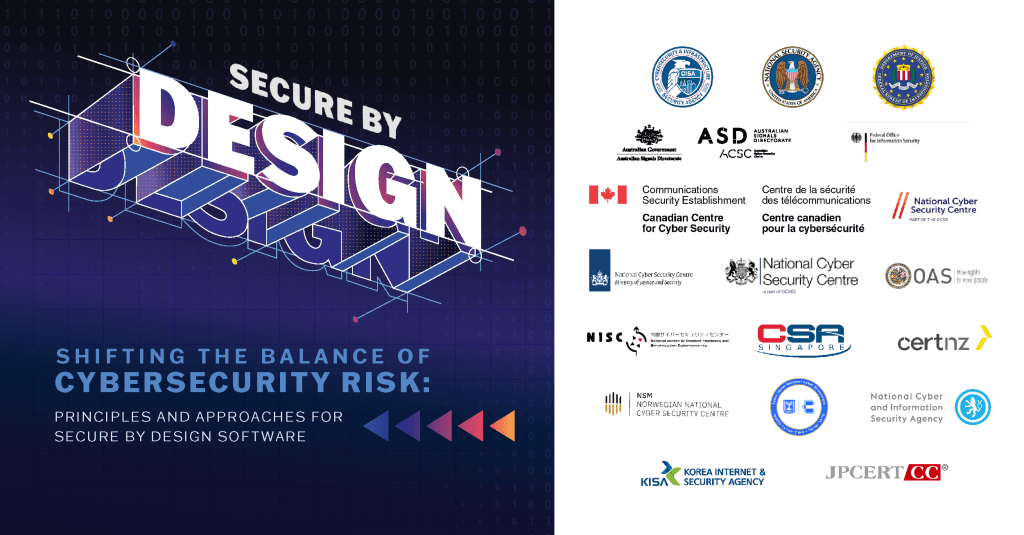
Joint international guidance co-sealed by CISA and global cybersecurity agencies establishing Secure by Design and Secure by Default principles.
Preventable Defects and National Security Exposure
Easterly points to a persistent gap between what engineering teams know how to prevent and what still ships in production. Of the 13 'unforgivable' software defects MITRE cataloged in 2007, 10 remained on MITRE's 2024 CWE Top 25 Most Dangerous Software Weaknesses list.
Coding failures such as memory-unsafe C/C++ development and SQL injection—flagged in CISA and FBI's Product Security Bad Practices—continue to expose network edge devices to exploitation by foreign adversaries, particularly actors affiliated with the People's Republic of China. When private utilities, hospitals, and critical infrastructure depend on defective edge software, routine coding flaws escalate into national security incidents.
The Secure by Design Pledge: From 68 to 250+ Signers
In May 2024, CISA introduced the voluntary Secure by Design Pledge with 68 founding software manufacturers—including Amazon Web Services, Cisco, Cloudflare, Google, IBM, Microsoft, Okta, and Palo Alto Networks. By January 2025, more than 250 companies had signed on and began publishing public progress reports, reinforced by initiatives such as Google's Secure by Design engineering work and Microsoft's Secure Future Initiative.
Signatories commit to making good-faith, publicly documented progress within one year across seven foundational goals for enterprise, on-premises, and cloud/SaaS software:
- Multi-factor authentication (MFA): Measurably increase MFA usage—especially phishing-resistant MFA and administrator defaults—and support baseline SSO.
- Default passwords: Eliminate universally shared default credentials via random instance-unique passwords or mandatory setup credentials.
- Reducing entire vulnerability classes: Eliminate bug families at scale through parameterized SQL queries, XSS-safe templates, and memory-safety roadmaps.
- Security patches: Increase customer patch adoption via automatic updates and clear end-of-life support timelines.
- Vulnerability disclosure policy (VDP): Publish safe-harbor testing policies, clear reporting channels, and coordinated disclosure.
- CVE transparency: Issue timely CVEs for critical/high flaws and populate accurate CWE and CPE fields in every record.
- Evidence of intrusions: Provide baseline audit logs (configuration changes, identity/token flows, data access) at no extra cost—retaining cloud/SaaS logs for at least six months.

CISA's voluntary Secure by Design Pledge commits enterprise software manufacturers to measurable public progress across seven security goals within one year.
Source: Cybersecurity & Infrastructure Security Agency (CISA) →
Ecosystem Accountability: CNAs and Customer Demand
Beyond vendor pledges, Easterly highlights expanding the roster of CVE Numbering Authorities (CNAs) so manufacturers assign timely, accurate identifiers for vulnerabilities in their own products rather than obscuring root causes. Just as safety ratings taught drivers which questions to ask car dealers, CISA's Secure by Design guidance equips buyers to demand secure defaults during procurement.
Ultimately, building a Secure by Design ecosystem extends past commercial vendors to open-source maintainers, universities, cyber insurers, venture capital firms, researchers, and regulators—aligning market and policy incentives so secure software becomes the baseline standard.
What It Means for Defenders
- Require Secure by Design criteria in software procurement: check whether vendors have signed the CISA Pledge, published progress reports, and operate as a CNA.
- Reject 'security tax' pricing models—verify that baseline products include SSO, phishing-resistant MFA, and at least 6 months of cloud/SaaS audit logs without paid-tier gating (CISA Bad Practices).
- Audit critical-infrastructure edge appliances for default credentials (CWE-1392/1393), missing admin MFA, and unpatched KEV components (CISA Bad Practices).
- Ask vendors for machine-readable SBOMs, published VDPs with safe harbor, and memory-safety roadmaps for network-facing C/C++ code (CISA Bad Practices).
Related Official Media
CISA — Secure By Design
Official CISA overview explaining why technology manufacturers must build cybersecurity into product design and defaults rather than shifting risk onto end users.