Eradicating Trivial Vulnerabilities, at Scale
UK NCSC research examines how memory-safe engineering, secure defaults, and platform-level guardrails can eliminate entire classes of 'unforgivable' software bugs.
- Author
- Ollie N (Head of Vulnerability Management Team, NCSC)
- Originating Desk
- UK National Cyber Security Centre (NCSC)
- Published
- Jan 28, 2025
- Region Scope
- EMEA

13
MITRE Unforgivable Classes (2007)
NCSC notes most of the 13 defect classes coined in 2007 still persist in software today.
1 / KLOC
Industry Defect Density Baseline
Cited in NCSC's technical paper (Coverity, 2019), while codebases double roughly every 3.5 years.
11
Top-Level Mitigations Scored
Ranked 3–9 across cost, knowledge, and technical feasibility against the 2023 CWE Top 25.
41%
XP-to-Vista Bug Reduction
Cited from Howard (2007) after banning unsafe C functions such as strcpy.
Why Misaligned Market Incentives Keep Trivial Bugs Alive
Published on January 28, 2025 by Ollie N, Head of the NCSC Vulnerability Management Team, Eradicating trivial vulnerabilities, at scale challenges the software industry to stop treating recurring, easily preventable security defects as an inevitable cost of software maintenance. While complex vulnerabilities are genuinely hard to eliminate, trivial recurring bugs drain defender resources year after year.
The post builds directly on Chapter 3 of the NCSC Annual Review 2024, which argues that technology markets have historically rewarded speed to market and new features over foundational security. Drawing on Volvo's decision to give away the three-point seat belt patent rather than compete on safety, the NCSC criticizes treating basic controls—such as MFA, SSO, and audit logging—as paid add-ons and identifies four levers to shift incentives: liability frameworks, financial rewards, transparency, and ecosystem consensus.
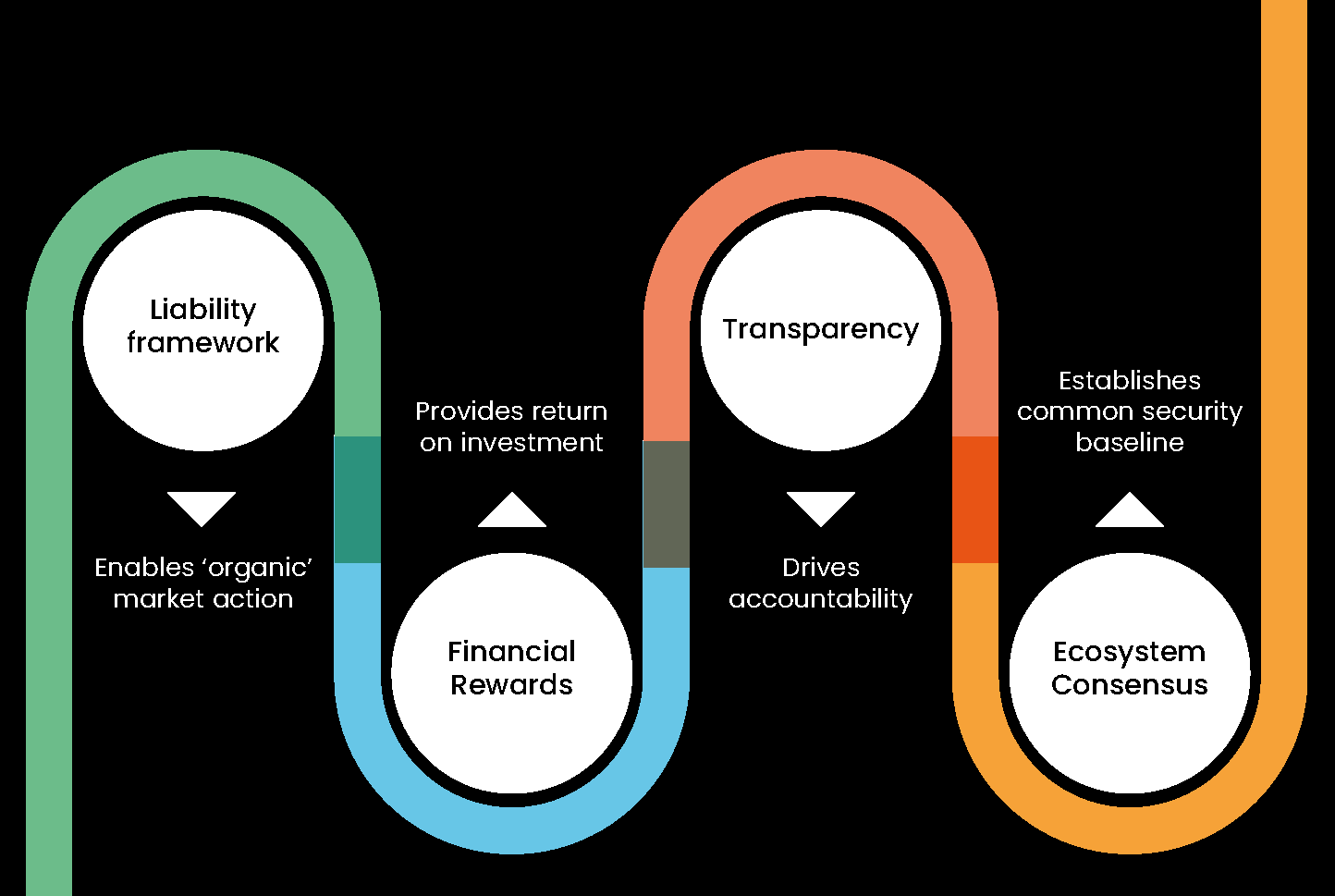
Four market drivers—liability, financial rewards, transparency, and ecosystem consensus—identified in Chapter 3 of the NCSC Annual Review 2024.
Source: UK National Cyber Security Centre (Annual Review 2024) →
From MITRE's 2007 Warning to NCSC's Assessment Method
The phrase 'unforgivable vulnerabilities' originates from Steve Christey's 2007 MITRE paper (spelled 'Steve Christie' in the NCSC blog), which described them as 'beacons of a systematic disregard for secure development practices' that should never appear in properly engineered software. Nearly two decades later, the NCSC notes that most of those 13 original classes remain widespread.
To move from rhetoric to measurement, the NCSC published an accompanying technical report—A method to assess 'forgivable' vs 'unforgivable' vulnerabilities. Rather than auditing surface symptoms, the paper maps root causes from the 2023 CWE Top 25 (derived from 43,996 CVE records from 2021–2022) and notes that industry defect density has remained near 1 defect per thousand lines of code (Coverity, 2019) while software codebases double roughly every 3.5 years (Hatton et al., 2017).
Scoring 11 Top-Level Mitigations Across the Stack
The NCSC framework evaluates 11 top-level mitigations by assigning each a score from 1 (easy/inexpensive) to 3 (hard/expensive) across three dimensions—direct and indirect Cost, Knowledge (how widely understood it is), and Technical Feasibility—assuming controls are built in from project inception rather than retrofitted. Combined totals classify mitigations as Easy (3–4), Medium (5–6), or Hard (7–9). Any vulnerability whose primary mitigation is rated Easy is classified as 'unforgivable':
- Easy (Score 3): Input Validation (1+1+1) and Output Encoding (1+1+1)—universally documented, low-cost, and native to modern frameworks.
- Medium (Score 5): Reduce the Attack Surface, Enforcement by Conversion, and Sandbox or Jail.
- Medium (Score 6): Secure Programming, Compilation or Build Hardening (such as `/GS` or `FORTIFY_SOURCE`), Separation of Privilege, and Libraries or Frameworks.
- Hard (Scores 7–8): Secure Architecture and Design (7) and Language Selection (8)—migrating millions of lines of legacy C/C++ to memory-safe languages like Rust, Swift, Go, or Kotlin carries high retrofit cost, even when greenfield adoption is straightforward.
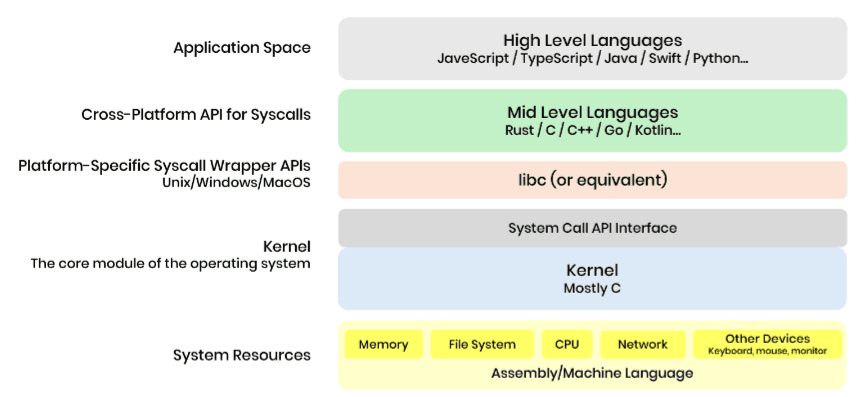
Figure 1 from the NCSC's companion technical paper illustrating the generic System Programming Stack across application, OS, and hardware layers.
Source: UK National Cyber Security Centre (image: iglu.net) →
Eradicating Vulnerability Classes via Platform & Policy Action
The NCSC emphasizes that lasting reductions require operating systems, development environments, and vendors to eliminate entire defect classes rather than relying on developer heroics alone. As precedent, the technical paper cites Howard (2007), showing a 41% vulnerability reduction between Windows XP and Windows Vista after banning unsafe C functions such as `strcpy`, alongside Chrome's adoption of third-party Rust libraries and hardware/OS research such as CHERI.
Internationally, the NCSC aligns this technical work with CISA's Secure by Design initiative, the White House ONCD's *Back to the Building Blocks* report, and the UK Government's voluntary Code of Practice for Software Vendors—signaling that further policy interventions are under exploration if voluntary uptake proves insufficient.
What It Means for Defenders
- Enforce Easy-tier mitigations—framework-native input validation, parameterized queries, and context-aware output encoding—via CI checks so injection and XSS defects are blocked before code review (NCSC Technical Report).
- Standardize new projects on memory-safe languages (Rust, Go, Swift, Kotlin, TypeScript, Python) and enable compiler/build hardening flags (`FORTIFY_SOURCE`, `/GS`, CET shadow stacks) on existing C/C++ components (NCSC Technical Report).
- Use OS-level privilege separation and sandboxing (AppArmor, SELinux, minimal service permissions) to contain flaws in legacy parsers and network-facing daemons (NCSC Technical Report).
- In procurement, evaluate whether software suppliers treat baseline security controls (MFA, SSO, audit logging) as built-in defaults rather than paid add-ons (NCSC Annual Review 2024).