Look What You Made Us Patch: 2025 Zero-Days in Review
Google Threat Intelligence Group tracked 90 zero-day vulnerabilities exploited in the wild during 2025, with enterprise edge and security appliances reaching 48% of targets.
- Author
- Casey Charrier, James Sadowski, Zander Work, Clement Lecigne, Benoît Sevens, and Fred Plan
- Originating Desk
- Google Threat Intelligence Group (GTIG)
- Published
- Mar 5, 2026
- Region Scope
- Global
90
Zero-Days Exploited in 2025
Up from 78 in 2024 and below the 2023 peak of 100, remaining within a 60–100 multi-year range.
48% (43)
Enterprise Technology Share
All-time high for enterprise targets; 21 targeted security and networking products.
18 vs. 15
CSV vs. State-Sponsored
For the first time, Commercial Surveillance Vendors exceeded state espionage groups in attributed flaws.
~35%
Memory Safety Vulnerabilities
Led by use-after-free (UAF) and out-of-bounds write across OS kernels and browsers.
Annual Volume Stabilizes While Attack Surfaces Shift
In its 2025 Zero-Days in Review published March 5, 2026, the Google Threat Intelligence Group (GTIG) tracked 90 zero-day vulnerabilities exploited maliciously in the wild before a patch became publicly available (with a December 31, 2025 cutoff). Every vulnerability in the 2025 dataset now has an available patch.
While 90 zero-days represents an increase over 2024's total of 78 and sits below 2023's record high of 100, the five-year trajectory from 2021 through 2025 (96, 63, 100, 78, and 90) remains sharply elevated above pre-2021 baselines of 32 in 2019 and 31 in 2020. As browser and mobile vendors raise exploit barriers, adversaries have pivoted toward other high-leverage layers rather than reducing overall zero-day usage.
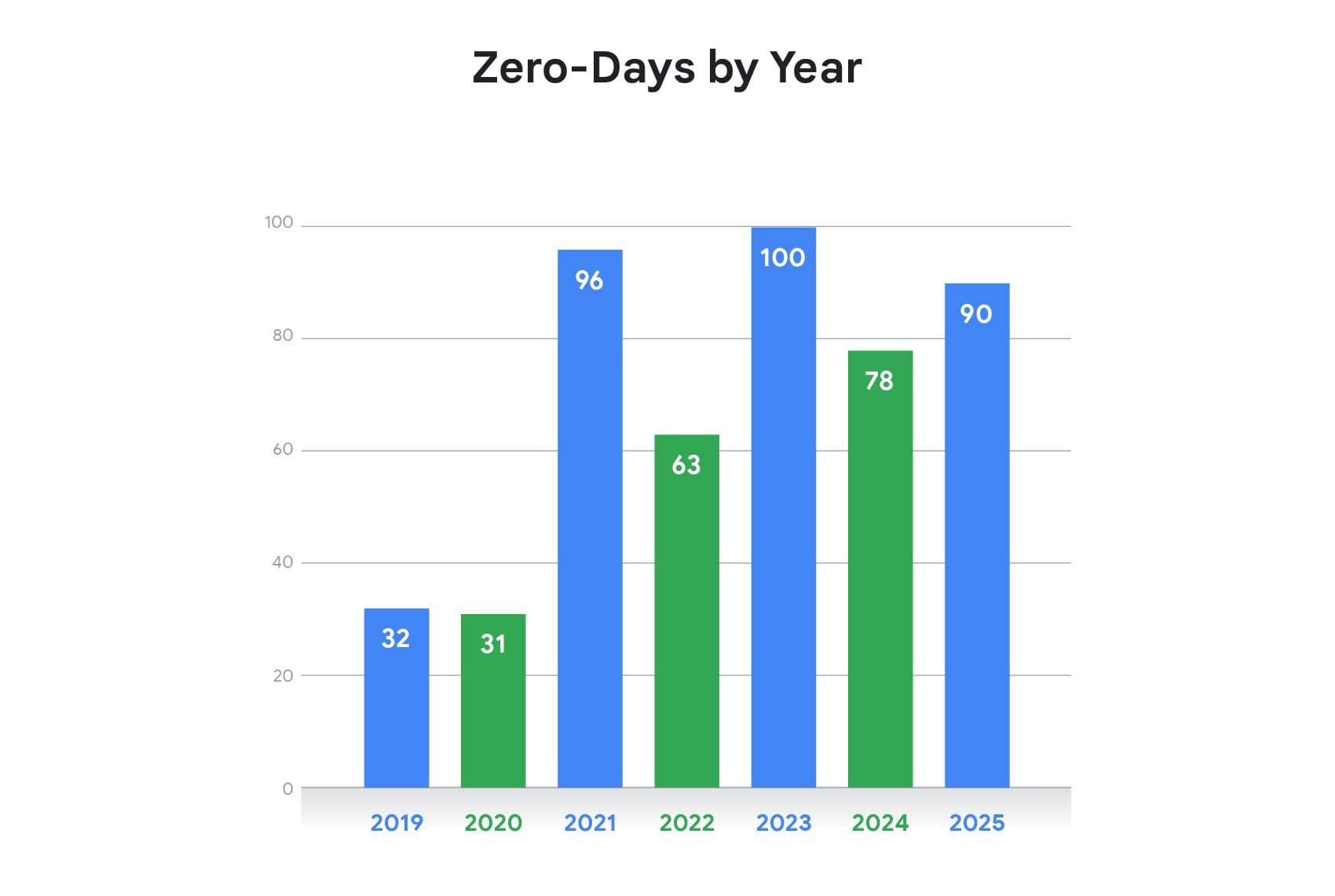
Figure 1: Annual zero-day vulnerabilities tracked in the wild from 2019 (32) through 2025 (90).
Enterprise Edge & Security Appliances Reach a Record 48%
Enterprise software and network appliances accounted for 43 vulnerabilities—48% of all 2025 zero-days—surpassing 2024's previous record of 36 (46%). Security and networking products represented roughly half of those enterprise targets (21 zero-days, or 23% of the overall total), spanning perimeter firewalls, VPN gateways, routers, and virtualization platforms.
GTIG warns that at least 14 zero-days affected edge devices specifically, a figure that likely undercounts real-world intrusions because most routers, switches, and security appliances lack endpoint detection and response (EDR) agents. By contrast, end-user platforms comprised 47 zero-days (52%): desktop and mobile operating systems rose to 39 flaws (44% of the total—24 desktop OS and 15 mobile, up from 9 mobile zero-days in 2024), whereas browsers fell to 8 zero-days (less than 10%), reflecting sustained browser sandboxing and memory-safety hardening.
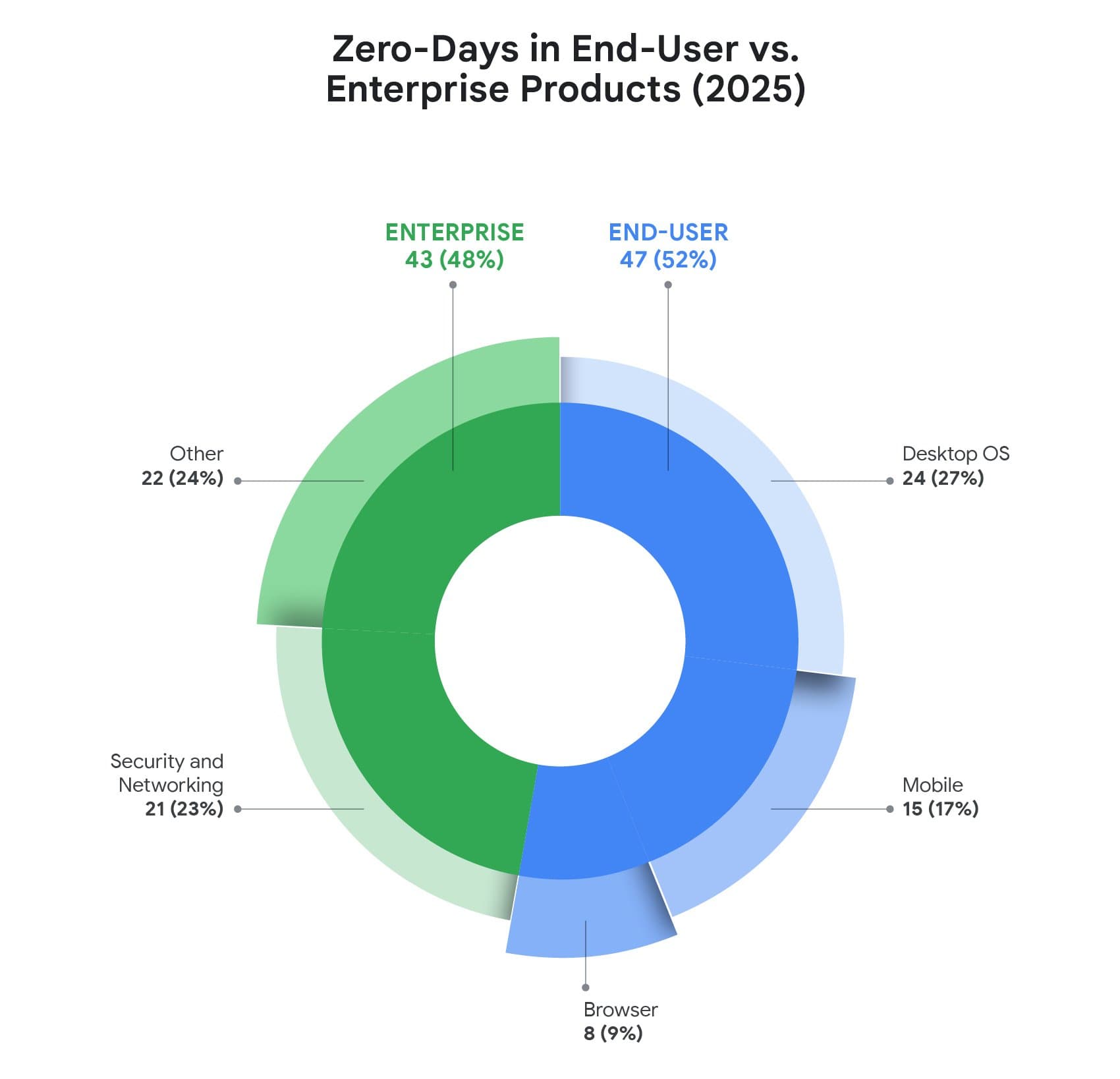
Figure 2: 2025 zero-days split between enterprise technologies (43, 48%) and end-user platforms (47, 52%).
Vendor Concentration and Dominant Vulnerability Classes
Target distribution by vendor mirrored consumer and enterprise market footprint. Among major platform vendors, Microsoft led with 25 exploited zero-days, followed by Google (11) and Apple (8). Among networking, VPN, and virtualization vendors, Cisco and Fortinet each recorded 4 zero-days, while Ivanti and VMware recorded 3 each. Beyond top targets, 6 vendors experienced two zero-days and 20 vendors saw a single zero-day each, illustrating attackers' willingness to hunt across a broad supplier tail.
Across all 90 flaws, remote code execution remained the primary objective, followed by privilege escalation. Four vulnerability patterns dominated the 2025 dataset:
- Injection and deserialization: Command injection and SQL injection in web-facing enterprise appliances offered reliable pre-auth code execution without memory-corruption complexity.
- Memory corruption (~35%): Use-after-free (UAF) and out-of-bounds write weaknesses remained heavily exploited in OS kernels and browser components.
- Access control bypasses: Authentication and authorization gaps persisted in administrative and perimeter interfaces.
- Logic and design flaws: Inherently insecure intended workflows in enterprise appliances proved difficult for vendors to catch prior to exploitation.
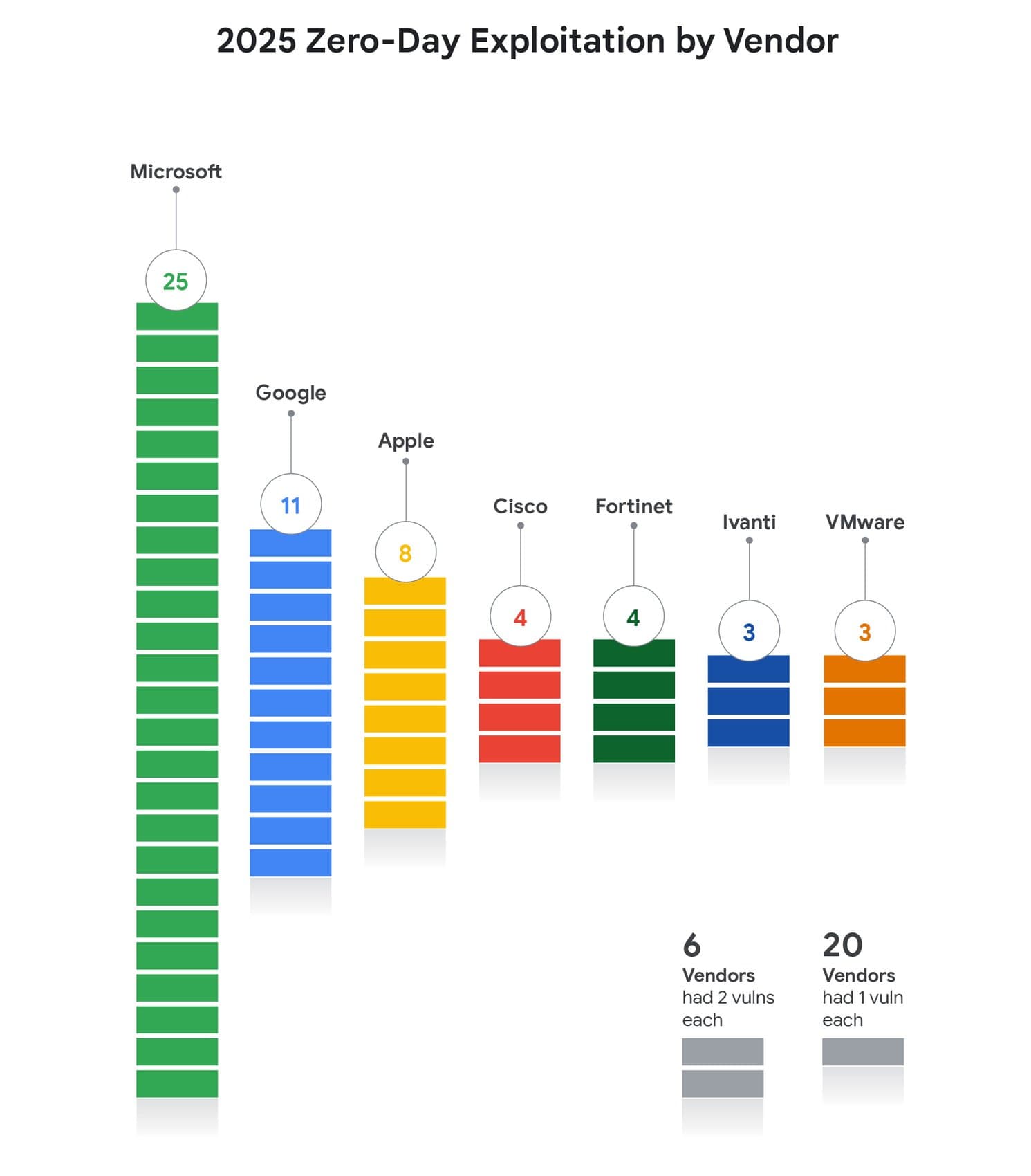
Figure 3: 2025 zero-day exploitation by vendor, alongside 6 vendors with two flaws and 20 vendors with one flaw each.
Attribution Milestone: Commercial Surveillance Vendors Lead
Across 42 uniquely attributed zero-days in 2025 (comprising 43 cluster attributions because one vulnerability was exploited independently by two groups), Commercial Surveillance Vendors (CSVs) surpassed traditional state-sponsored espionage actors for the first time. GTIG linked 18 zero-days to CSVs (15 confirmed, 3 likely), including adaptive spyware operations such as Intellexa, compared to 15 linked to state-sponsored espionage groups (12 confirmed, 3 likely PRC-nexus).
People's Republic of China (PRC)-nexus cyber espionage groups remained the most prolific state users of zero-days, accounting for at least 10 zero-days (7 confirmed and 3 likely in Figure 4)—double the 5 attributed in 2024 and near 2023's 12—including UNC3886 exploiting CVE-2025-21590 on Juniper routers and UNC5221 exploiting CVE-2025-0282 on Ivanti Connect Secure. By contrast, GTIG attributed zero zero-days to North Korean groups in 2025, down from 5 in 2024.
Financially motivated threat actors tied near-record levels with 9 attributed zero-days (up from 5 in 2024 and just below 10 in 2023), including two zero-days tied to ransomware deployment. Notable activity included FIN11/CL0P's Oracle E-Business Suite campaign exploiting CVE-2025-61882 and/or CVE-2025-61884 as early as August 9, 2025, and UNC2165 (Evil Corp overlap) plus RomCom/UNC4895 exploiting WinRAR vulnerability CVE-2025-8088.
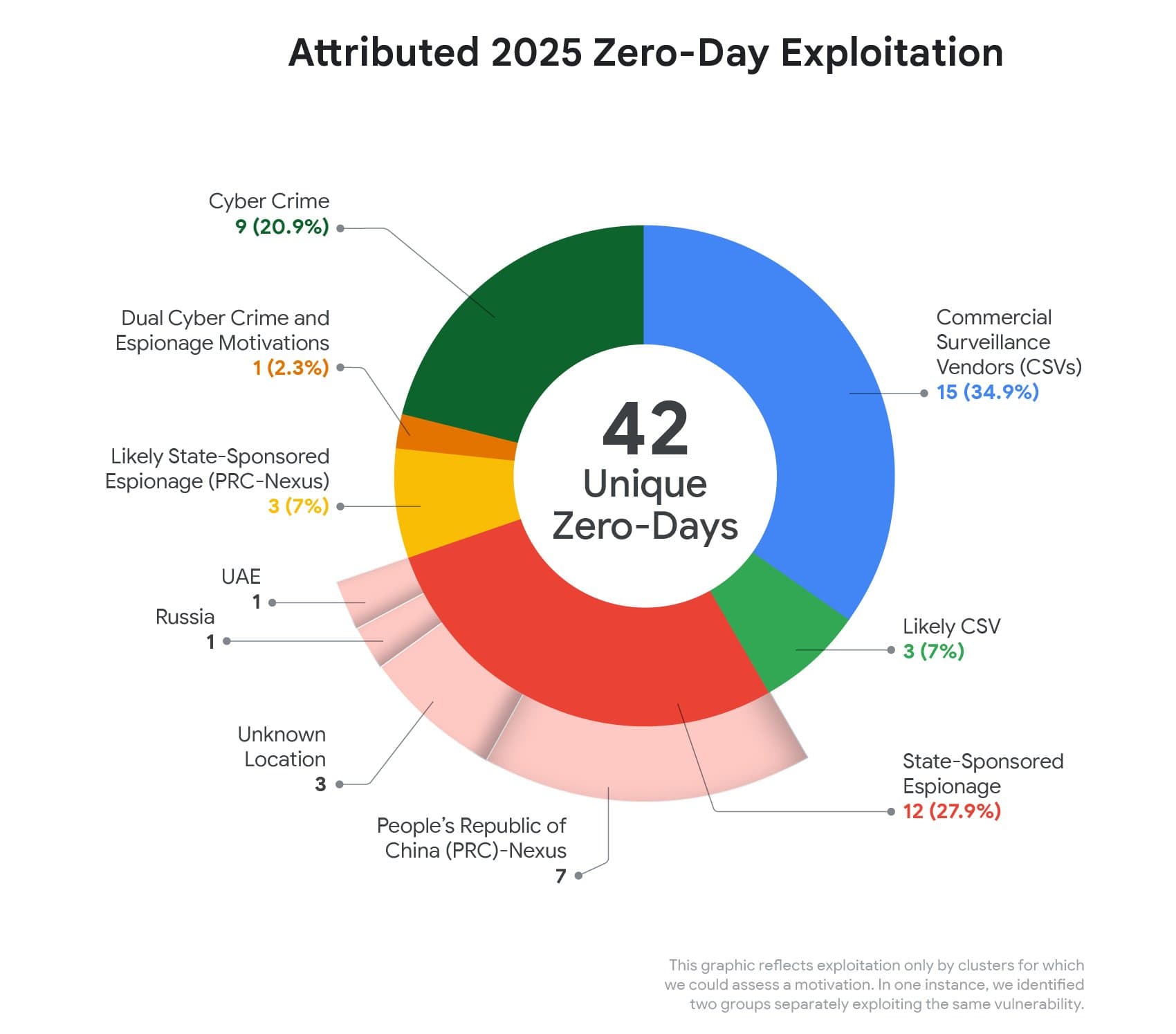
Figure 4: Attribution across 42 unique 2025 zero-days (43 cluster attributions where two groups independently exploited one flaw).
Technical Spotlights and the 2026 Forecast
GTIG's technical spotlights illustrate how attackers adapt when browsers and mobile sandboxes harden. Every 2025 browser sandbox escape GTIG analyzed targeted OS or GPU driver boundaries rather than generic browser sandbox logic—spanning Windows sentinel handle handling in CVE-2025-2783, Android Runtime object deserialization (CVE-2025-48543), Qualcomm Adreno GPU UAF (CVE-2025-27038), ARM Mali GPU OOB write (CVE-2025-6558), and Apple Metal GPU OOB access (CVE-2025-14174).
In enterprise appliances, GTIG uncovered a multi-stage SonicWall SMA 1000 exploit chain combining an n-day SSO authentication bypass (CVE-2025-23006) and a silently patched 2024 Java deserialization RCE with a loopback Python XML-RPC zero-day (CVE-2025-40602) for root escalation. On Android, Project Zero and GTIG examined how Samsung's unsandboxed Quram DNG parser (`com.samsung.ipservice`) turned single memory-corruption bugs (CVE-2025-21042, alongside zero-days CVE-2025-21043 and CVE-2025-43300) into reliable code execution without PAC/BTI protections.
Looking into 2026, GTIG warns that BRICKSTORM espionage campaigns stealing vendor source code and proprietary design documents signal a shift toward using intrusion access to fuel long-term zero-day research, while AI will accelerate both adversary exploit development and defender vulnerability discovery.
What It Means for Defenders
- Segment DMZ appliances, firewalls, and VPNs from core networks and domain controllers, and close unnecessary internet-exposed management ports (GTIG 2025 Review).
- Maintain an up-to-date asset inventory and Software Bill of Materials (SBOM), and establish emergency out-of-band patching procedures when zero-day fixes or stop-gap mitigations ship (GTIG 2025 Review).
- Monitor for Living-off-the-Land (LotL) and anomalous kernel behavior using process baselines, strict driver blocklists, and canary tokens—especially where edge appliances lack EDR (M-Trends / GTIG).
- Protect high-risk personal devices with Google Advanced Protection, Android Advanced Protection Mode, iOS Lockdown Mode, regular reboots, and prompt OS updates (GTIG 2025 Review).