Fortinet FortiOS & FortiProxy SSL VPN Out-of-Bounds Write
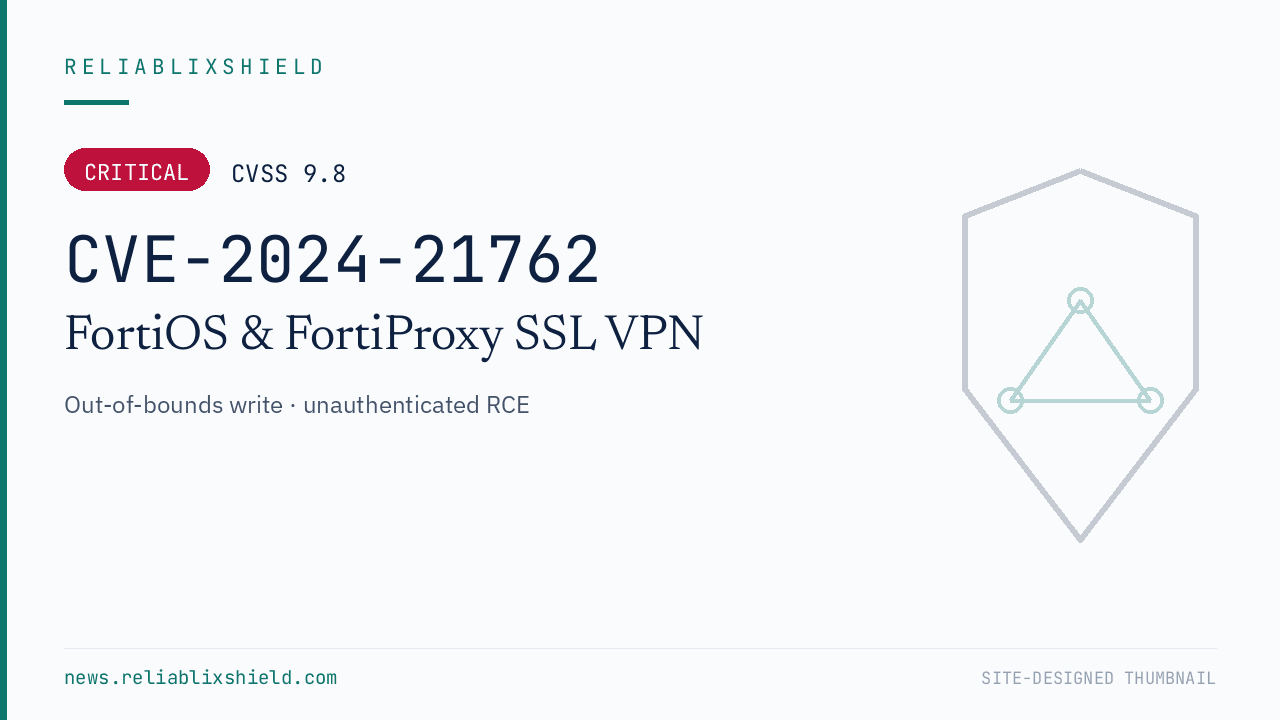
Crafted HTTP requests to the Fortinet SSL VPN service trigger an out-of-bounds write that allows unauthenticated remote code execution.
- CVE Identifier
- CVE-2024-21762
- CVSS v3.1 Base Score
- 9.8 (Critical)
- Published Date
- Feb 9, 2024
- Scope / Region
- Global
- Affected Products
- Fortinet FortiOS (7.4.0–7.4.2, 7.2.0–7.2.6, 7.0.0–7.0.13, 6.4, 6.2, 6.0) & FortiProxy SSL VPN
Technical Summary
Assigned a CVSS v3.1 base score of 9.8 Critical by Fortinet CNA and NVD (with a 9.6 temporal score listed in FG-IR-24-015), CVE-2024-21762 affects multiple branches of FortiOS and FortiProxy when the SSL VPN daemon is exposed. CISA added the flaw to its Known Exploited Vulnerabilities catalog after observing active exploitation in the wild.
Fortinet released fixed firmware across supported branches—including FortiOS 7.4.3, 7.2.7, 7.0.14, 6.4.15, 6.2.16, and 6.0.18—and warned that disabling webmode alone is not a valid workaround; full SSL VPN must be disabled if immediate upgrades are not possible.
Defender Briefing: Mechanism, Impact & Response
What Happened
- An out-of-bounds write (`CWE-787`) in `sslvpnd` within FortiOS and FortiProxy lets remote unauthenticated attackers execute arbitrary code or commands via crafted HTTP requests (Fortinet PSIRT).
- Fortinet noted the vulnerability was potentially being exploited in the wild at disclosure, and CISA listed it in the KEV Catalog (CISA KEV).
Impact
- CVSS v3.1 base score 9.8 Critical (`AV:N/AC:L/PR:N/UI:N/S:U/C:H/I:H/A:H`) across FortiOS 6.0–7.4 and FortiProxy 1.0–7.4 branches (NVD).
What to Do
- Upgrade to FortiOS 7.4.3+, 7.2.7+, 7.0.14+, 6.4.15+, 6.2.16+, or 6.0.18+, and FortiProxy 7.4.3+, 7.2.9+, 7.0.15+, or 2.0.14+ (Fortinet PSIRT).
- If immediate patching is delayed, disable SSL VPN completely (Fortinet notes disabling SSL VPN webmode alone does not mitigate this flaw) and deploy IPS virtual patch `HTTP.Chunk.Length.Invalid.` (Fortinet PSIRT).
Disclosure & Patch Timeline
- Fortinet PSIRT published initial advisory FG-IR-24-015 with fixed firmware releases.
- CVE-2024-21762 published in NVD and added to CISA's Known Exploited Vulnerabilities catalog.
Public References
- Fortinet / CVE Program (Primary Record):https://www.cve.org/CVERecord?id=CVE-2024-21762 →
- Fortinet PSIRT Advisory (FG-IR-24-015):https://www.fortiguard.com/psirt/FG-IR-24-015 →
- NVD Vulnerability Record (CVE-2024-21762):https://nvd.nist.gov/vuln/detail/CVE-2024-21762 →
- CISA KEV Catalog Entry (CVE-2024-21762):https://www.cisa.gov/known-exploited-vulnerabilities-catalog?field_cve=CVE-2024-21762 →