XZ Utils (liblzma) Upstream Supply Chain Backdoor
Malicious build-time code introduced into XZ Utils 5.6.0 and 5.6.1 modified liblzma to intercept OpenSSH authentication via systemd dependencies.
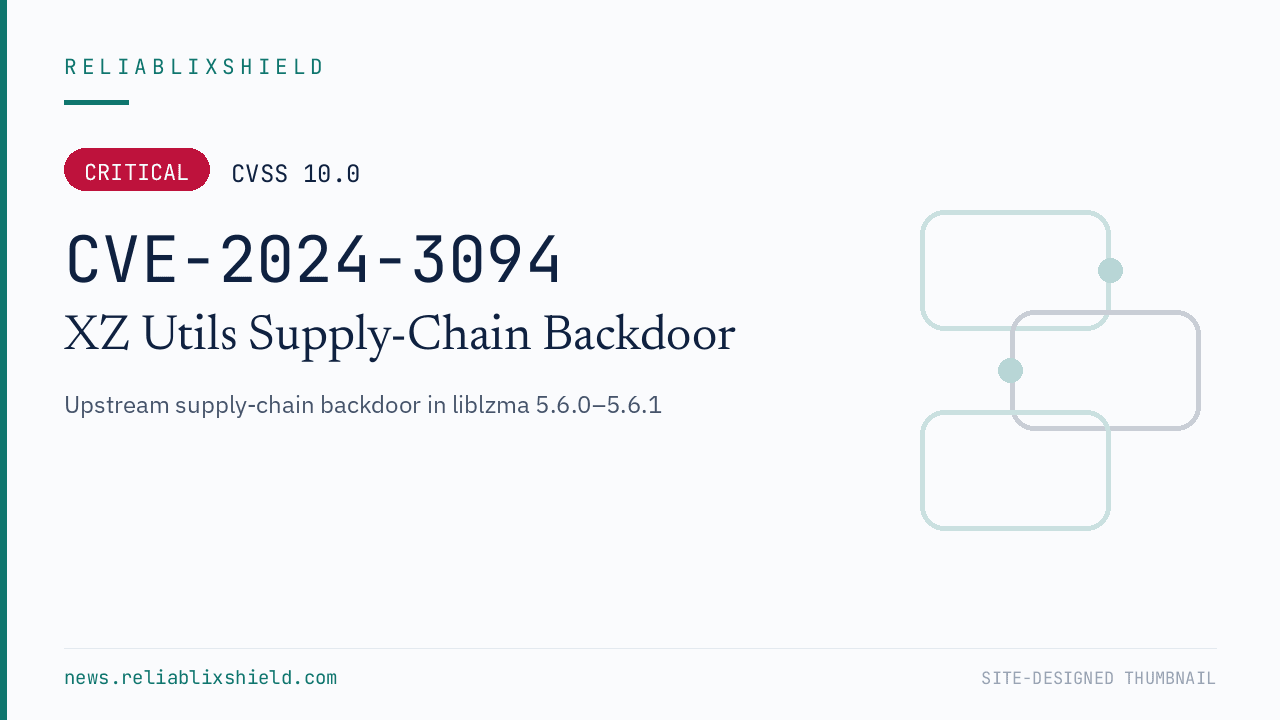
- CVE Identifier
- CVE-2024-3094
- CVSS v3.1 Base Score
- 10.0 (Critical)
- Published Date
- Mar 29, 2024
- Scope / Region
- Global
- Affected Products
- XZ Utils (liblzma 5.6.0–5.6.1)
Technical Summary
Tracked under CVE-2024-3094 with a CVSS v3.1 base score of 10.0, obfuscated test files in upstream XZ Utils release tarballs injected a prebuilt object file into liblzma during compilation on affected Linux distributions. On systems linking OpenSSH sshd with liblzma through systemd, the modified library hooked RSA_public_decrypt to permit unauthorized remote code execution.
Linux distributions responded by reverting XZ Utils packages to uncompromised 5.4.x releases (such as 5.4.6) and advising operators who installed 5.6.0 or 5.6.1 builds to downgrade immediately.
Defender Briefing: Mechanism, Impact & Response
What Happened
- Obfuscated test artifacts (`tests/files/bad-3-corrupt_lzma2.xz` and `good-large_compressed.lzma`) committed upstream were extracted by a malicious `build-to-host.m4` macro present only in XZ Utils 5.6.0 and 5.6.1 release tarballs, injecting a prebuilt object file (`liblzma_la-crc64-fast.o`) during x86_64 Linux Debian/RPM package builds (oss-security).
- The modified `liblzma` replaced IFUNC resolvers (`crc32_resolve` / `crc64_resolve`) and installed a dynamic-linker audit hook to redirect `RSA_public_decrypt` in `sshd` on distributions linking OpenSSH with `libsystemd` (oss-security).
Impact
- Scored 10.0 Critical under CVSS v3.1 (`AV:N/AC:L/PR:N/UI:N/S:C/C:H/I:H/A:H`), the pre-authentication hook enabled unauthorized remote access or code execution via SSH on affected x86_64 glibc Linux builds (NVD).
- Mainstream production distributions were largely spared because 5.6.0 and 5.6.1 primarily reached rolling, unstable, or pre-release channels such as Fedora Rawhide, Fedora 41, and Debian Sid (Red Hat).
What to Do
- Verify installed `xz` and `liblzma` package versions across Linux hosts and container images, and immediately downgrade any 5.6.0 or 5.6.1 installation to an uncompromised 5.4.x release (CISA).
- Rebuild or re-image any host or build runner that ran `sshd` against compromised `liblzma` 5.6.0/5.6.1 packages while exposed to untrusted networks (Red Hat).
Disclosure & Patch Timeline
- Disclosed publicly; upstream 5.6.0/5.6.1 tarballs flagged and downstream distributions initiated downgrades to uncompromised 5.4.x packages.
Public References
- CVE Program / Red Hat CNA (Primary Record):https://www.cve.org/CVERecord?id=CVE-2024-3094 →
- NVD Vulnerability Record (CVE-2024-3094):https://nvd.nist.gov/vuln/detail/CVE-2024-3094 →
- oss-security Disclosure by Andres Freund:https://www.openwall.com/lists/oss-security/2024/03/29/4 →
- Red Hat Urgent Security Alert (Fedora 41 & Rawhide):https://www.redhat.com/en/blog/urgent-security-alert-fedora-41-and-rawhide-users →
- CISA Advisory on XZ Utils Supply Chain Compromise:https://www.cisa.gov/news-events/alerts/2024/03/29/reported-supply-chain-compromise-affecting-xz-utils-data-compression-library-cve-2024-3094 →